Screeding a Home Extension: When It Fits in Your Build Schedule and Why It Matters
Planning to screed your home extension in Somerset or Dorset? Here's exactly what's involved, when it happens in the build, and how to get the best result.

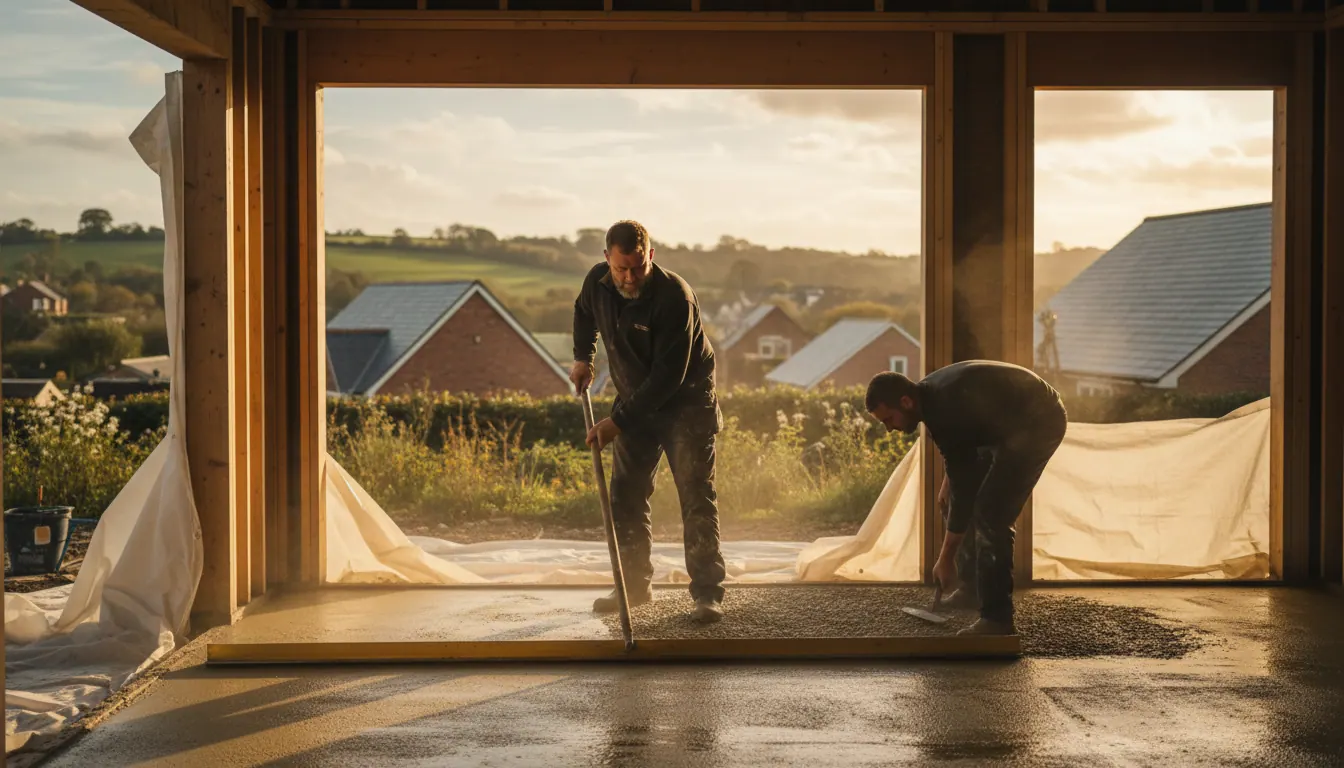
The floor screed is one of the last things people think about, and one of the first that can hold up a build
You've got the walls up, the roof on, the windows in. The plumber has been through and the underfloor heating pipes are laid and pressure-tested. Now everyone is waiting for the floor to be screeded before the next trades can move in.
This is the moment a lot of extension projects either flow smoothly or grind to a halt. The screed pour itself is fast. The preparation, the sequencing and the drying afterwards take planning. Get those things right and you move straight on to floor finishes. Get them wrong and you're waiting weeks longer than you need to.
We screed extensions, renovations and new builds across Somerset and Dorset, including jobs in Taunton, Bridgwater, Yeovil and Weston-super-Mare. This is a practical guide to what the process actually looks like, when it fits into your build programme, and what needs to be in place before we turn up.
Where screeding sits in your extension build programme
The screed goes in after the structural work, roofing, windows, external doors and first-fix plumbing and electrics are complete. If you have underfloor heating, the heating installer lays and pressure-tests the pipes first, and those pipes need to stay pressurised while we pour so we can see immediately if anything is disturbed.
The rough order looks like this:
- Subfloor prepared and clean (no rubble, standing water or loose material)
- Insulation boards laid
- Damp-proof membrane in place
- Perimeter edge insulation fitted around the walls
- Underfloor heating pipes laid and tested (where applicable)
- Screed poured
We can carry out the floor preparation stages ourselves, including laying the insulation, membrane and perimeter edging, if that is easier for you or your main contractor. Some builders prefer to handle that themselves; others want us to take care of the whole floor build-up. Either works.
What matters is that none of these steps are skipped. The insulation reduces heat loss downwards. The membrane protects against ground moisture. The perimeter edging allows the screed to expand and contract without cracking. These are not optional extras; they are what make the finished floor perform properly.
Why liquid screed suits extensions so well
Traditional sand and cement screed has been used for decades and still has its place. But for most modern extensions, particularly those with underfloor heating, liquid screed (also called flow screed or self-compacting screed) is the better choice.
Here is why.
Liquid screed is pumped in and flows around underfloor heating pipes, encasing them fully without air pockets. Air pockets around pipes reduce heat transfer, which means your underfloor heating works less efficiently than it should. Liquid screed eliminates that problem.
It also self-levels, which means it produces a flat, consistent surface with far less manual labour than sand and cement. For extensions where you need the new floor to meet an existing floor at a precise level, that accuracy matters.
And it is faster to pour. A large extension floor that would take a team of plasterers a full day or more with sand and cement can often be poured in a fraction of that time with a liquid screed pump. Less time on site, less disruption to your build programme.
If you want to go deeper on the comparison, we have written a full breakdown here: Liquid Screed vs Sand and Cement: Which Suits a Somerset Home?
What the pour actually looks like on the day
The screed arrives by truck and is pumped through a hose into the floor area. We guide it around the space, check levels as we go, and the material flows to fill the area evenly. Once it is down, we do a final check across the surface and leave it to begin its cure.
The floor will be firm enough to walk on carefully within 24 to 48 hours in most conditions. But firm enough to walk on is very different from dry enough to lay floor finishes. Liquid screed needs to dry thoroughly before tiles, wood, vinyl or any other floor covering goes down. Rushing that stage is one of the most common causes of flooring problems.
For a detailed guide to drying times and when different floor finishes can go down, see: How Long Until You Can Lay Tiles After Floor Screeding? A Bridgwater Homeowner's Timeline
Getting the preparation right before we arrive
The single biggest thing that affects the quality of the finished screed is the state of the subfloor and the preparation underneath. A well-prepared floor gives us a clean, stable base to pour onto. A poorly prepared one creates problems that are difficult and expensive to fix after the event.
Before we pour, the floor area needs to be:
- Clear of all debris, dust and standing water
- Structurally sound, with no soft or unstable areas
- Insulated and membraned correctly
- Fitted with perimeter edge strip around every wall and column
- Heated pipes (if present) laid flat, secured and pressure-tested
Ventilation matters too. In Somerset and Dorset, extension builds often run into the autumn and winter months when temperatures drop and moisture levels rise. A cold or damp subfloor can affect how the screed cures. We will always check conditions before we pour and advise if anything needs addressing first.
For a full preparation checklist, this article covers everything in detail: Preparing Your Floor for Liquid Screed: A Somerset Checklist
What our customers say
Getting the details right, from preparation through to the finish, is something we take seriously on every job. Josh, a recent customer, put it simply:
Really happy with the work. The finish was spot on and you can tell a lot of care and attention went into getting everything right. Turned up when he said he would, worked hard and left everything tidy afterwards. Would definitely recommend to anyone looking for a reliable and professional screeding service.
Josh Phillips
That combination of a good finish and a tidy, reliable job matters on extension builds, where multiple trades follow on behind. A screed that is flat, level and left in good condition makes every subsequent trade's job easier.
Screeding for underfloor heating in an extension
Most new extensions in Somerset and Dorset are built with underfloor heating rather than radiators. It is efficient, it keeps walls clear, and it works well with the open-plan layouts that most modern extensions use.
Liquid screed and underfloor heating are genuinely well matched. The screed encases the pipes fully, conducts heat evenly across the floor, and produces the consistent surface temperature that makes underfloor heating feel comfortable underfoot.
One thing to be aware of: after the screed is poured and has dried sufficiently, the underfloor heating needs to be commissioned correctly before floor finishes go down. This involves gradually bringing the system up to temperature over a number of days, a process sometimes called a "heating protocol" or "commissioning cycle". This is your heating engineer's job, not ours, but it needs to happen before any wood or engineered floor goes down, and we are happy to advise on the sequence.
More detail on how screed and underfloor heating work together is here: Underfloor Heating and Liquid Screed: A Somerset Guide
Frequently asked questions
Is screed the same as sand and cement?
Sand and cement screed is one type of screed, the traditional kind mixed on site and laid by hand. Liquid screed is a different material, pumped in and self-levelling. Both are used to create a flat floor surface, but they have different properties, different applications and different drying times. For most modern extensions with underfloor heating, liquid screed is the more practical choice.
Is screeding the same as plastering?
No. Plastering applies a finish to walls and ceilings. Screeding creates a flat, level surface on a floor, either as the finished floor itself or as a base for tiles, wood or other floor coverings. The two trades use different materials and different techniques, though both require a good eye for a level finish.
How thick does a liquid screed need to be in an extension?
The right depth depends on whether you have underfloor heating pipes to cover, the type of liquid screed being used, and what floor finish will go on top. We assess each job individually and advise on the correct depth for your specific situation. Getting this right matters: too thin and the screed can crack; too deep and you may have a level issue where the new floor meets an existing one.
Do I need to tell my builder anything before the screed contractor arrives?
Yes. Make sure your builder knows that the floor needs to be fully cleared, the insulation and membrane laid, and the perimeter edging fitted before we arrive. If you have underfloor heating, the pipes need to be laid, secured and pressure-tested. Checking these things in advance avoids delays on the day. We are happy to talk through the sequence with you or your builder at the quotation stage.
Ready to get your extension floor sorted?
If you are planning an extension, renovation or self-build across Somerset or Dorset, including in Bridgwater, Taunton, Yeovil or Weston-super-Mare, we would be glad to help. Tell us your floor area and location and we will give you a free, no-obligation quote.
Get in touch with us here and we will get back to you promptly.