Underfloor Heating and Liquid Screed: A Somerset Guide
How liquid screed works with underfloor heating in a Somerset renovation or extension: what to get ready before the pour and how to treat the floor after.

If you are renovating or extending a home in Somerset or Dorset and putting in underfloor heating, you will be told at some point that the floor needs screeding before any floor finish can go down. This guide explains what the screed does, what has to be ready before the pour, and how to treat the floor afterwards.
It covers wet underfloor heating, meaning systems that circulate warm water through pipes laid across the floor.
What the screed does over underfloor heating
A screed is the layer that sits over the floor insulation and under the final floor finish. On a heated floor it does three things:
- It encases the heating pipes and protects them.
- It takes heat from the pipes and spreads it across the room, so the floor warms as a whole rather than in stripes above each pipe.
- It gives a smooth, level surface for tiles, vinyl, wood or carpet.
Why liquid screed suits underfloor heating
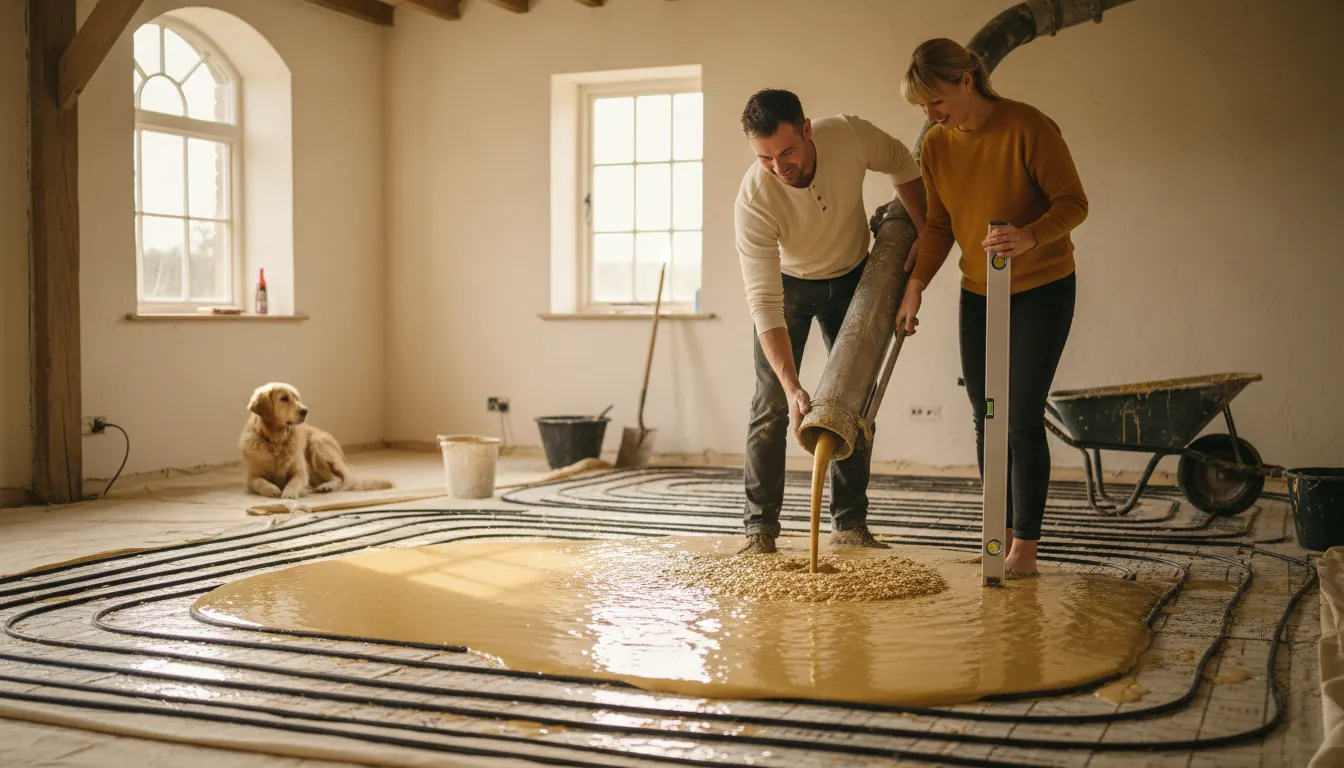
Traditional screed is a semi-dry mix of sand and cement that is spread and compacted by hand. Liquid screed is pumped through a hose as a fluid and flows to its own level. Over underfloor heating, that difference matters in two ways.
It surrounds the pipes completely. Liquid screed flows around every pipe without leaving air pockets. Full contact between pipe and screed helps the warmth pass into the floor evenly.
It is typically laid thinner than traditional screed. There is less material to warm up, so the floor responds more quickly when the heating comes on.
There is a practical benefit in renovations too. Fitting insulation, pipes and screed into an existing house means working to fixed points such as door thresholds, stairs and the floors of neighbouring rooms. A thinner screed can make that build-up easier to fit. The right depth for your floor depends on the pipes and the screed being used, so it should be agreed against the manufacturer's guidance rather than guessed.
Who does what
A heated floor involves several trades.
- Your builder normally prepares the base, lays the insulation and fits the membrane and edging strip.
- Your heating installer designs and lays the pipework, then fills and tests it.
- The screeding contractor supplies and installs the screed over the top.
Somerset Screed Company are liquid screed specialists. We supply and install liquid screed, including underfloor heating screeds, for domestic, new build and commercial projects. We do not install underfloor heating, insulation or membranes, so those need to be complete before we arrive.
What has to be ready before the pour
Five things need to be in place:
- The building should be weathertight, with the roof on and openings closed or covered.
- Insulation boards must sit flat and tight. Boards that rock, or have gaps between them, cause problems once the screed is on top.
- The floor must be watertight. A membrane, usually a polythene sheet, is laid over the insulation with the joints lapped and taped, and a foam edging strip runs around the perimeter of the room. Together they form a tray that holds the liquid screed.
- Pipes must be fixed down securely. Pipes that are not held firmly can lift when the screed flows around them.
- The system must be filled and pressure-tested. A test before the pour finds any leak while the pipes can still be reached. Ask your heating installer to confirm it has been done, and whether the system should stay under pressure during the pour.
It is also worth asking whether movement joints are needed, for example at doorways or between heating zones that are controlled separately. A movement joint is a planned break in the screed that lets each section expand and contract on its own.
After the pour: drying and turning the heating on
The fresh screed needs to be left alone at first, and then it needs ventilation and time to dry. How long depends on the depth of the screed and the conditions on site, so there is no fixed date.
The underfloor heating can help with drying, but only if it is used carefully. It should be brought up gradually, following the guidance from the screed manufacturer and the heating manufacturer. Turning a new system straight up to full temperature risks damaging the screed.
Floor finishes should only go down once a moisture test says the screed is dry. A floor can look and feel dry at the surface while still holding moisture lower down, and laying a finish too early is a common cause of problems later.
One more point to raise with your installer: some liquid screeds leave a thin surface layer that needs removing before floor finishes are laid. Ask whether that applies to your floor.
Planning it into a renovation
In an extension or renovation, whether that is a kitchen in Taunton or a whole ground floor in Weston-super-Mare, the screed comes at a turning point in the job. The structural work is finished and the building is closed in, but the finishes have not started.
Three things help it go smoothly:
- Settle the floor levels early, before the insulation and pipes go in.
- Book the pour once the heating installer has a firm date for finishing and testing the pipework.
- Allow for drying time in the programme before kitchens, flooring and skirting are fitted.
Questions to ask before you book
- What depth of screed is right for my pipes and my floor build-up?
- What exactly needs to be in place before the day of the pour?
- When can the floor be walked on, and when can the heating be switched on?
- How will the screed be tested before floor finishes go down?
We work across Somerset, Dorset and the surrounding areas, and builders and trade enquiries are welcome. Message us with your floor area and location for a free quotation.
“2 days ago 2d Really happy with the work. The finish was spot on and you can tell a lot of care and attention went into getting everything right. Turned up when he said he would, worked hard and left everything tidy afterwards. Would definitely recommend to anyone looking for a reliable and professi…”