Liquid Screed for Uneven Floors in Older Somerset Homes: How It Levels Problem Floors
Uneven floors in your Somerset home or new build? We explain how liquid screed levels them and what the process involves from prep to pour.

Uneven floors are more common than you might think
Old houses settle. Ground floors in properties across Somerset and Dorset shift over decades, and what was once a level slab becomes a surface that rocks a tile, lifts a laminate board or makes a kitchen unit sit at an angle. Newer builds are not immune either. Concrete slabs poured in a hurry, or floor areas that have been altered during a renovation, can leave you with a base that simply is not good enough for the floor finish you want.
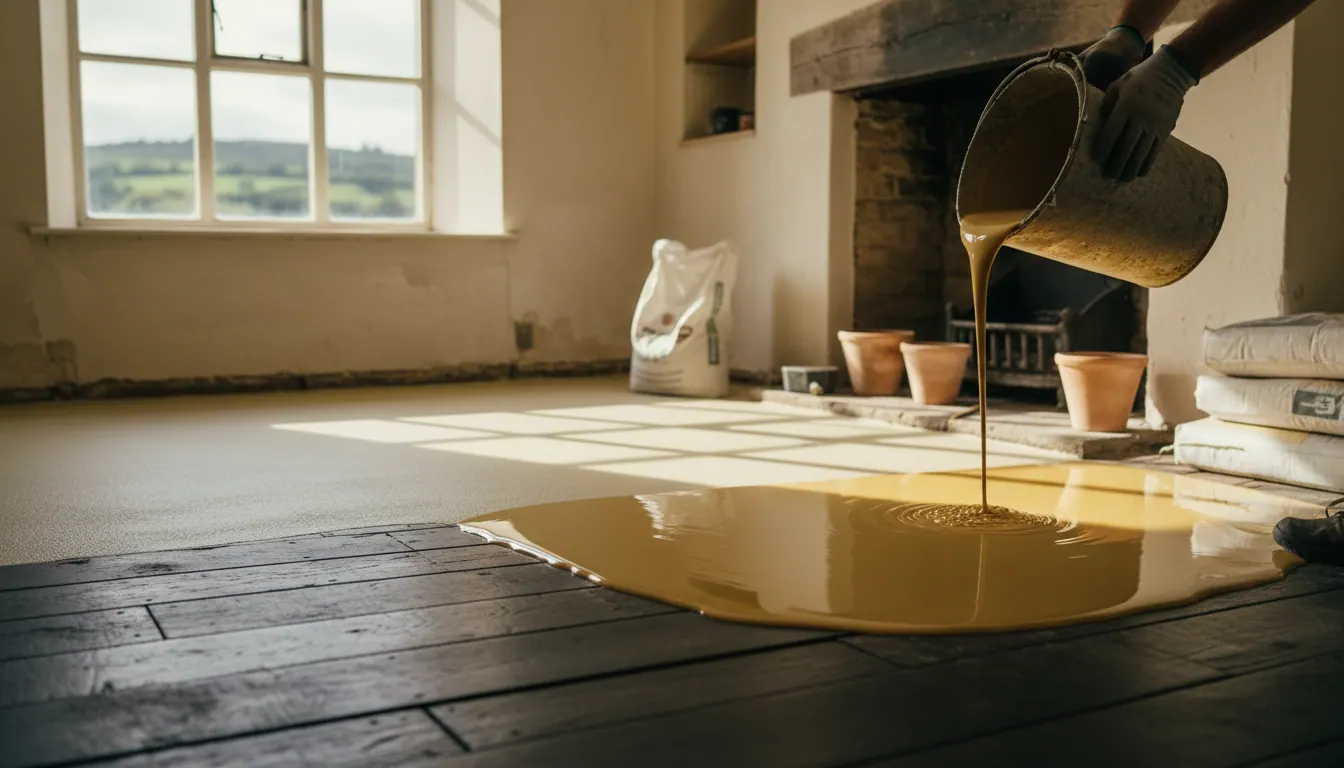
Liquid screed is one of the most effective ways to deal with this. It flows into low spots, self-levels across the floor and sets with a flat, consistent surface that is ready for whatever finish goes on top. If you are planning a renovation, extension or new build anywhere in Somerset or Dorset, and your floor is not as flat as it needs to be, this article explains how the process works and what you need to think about before booking.
What liquid screed actually is (and why it suits uneven floors)
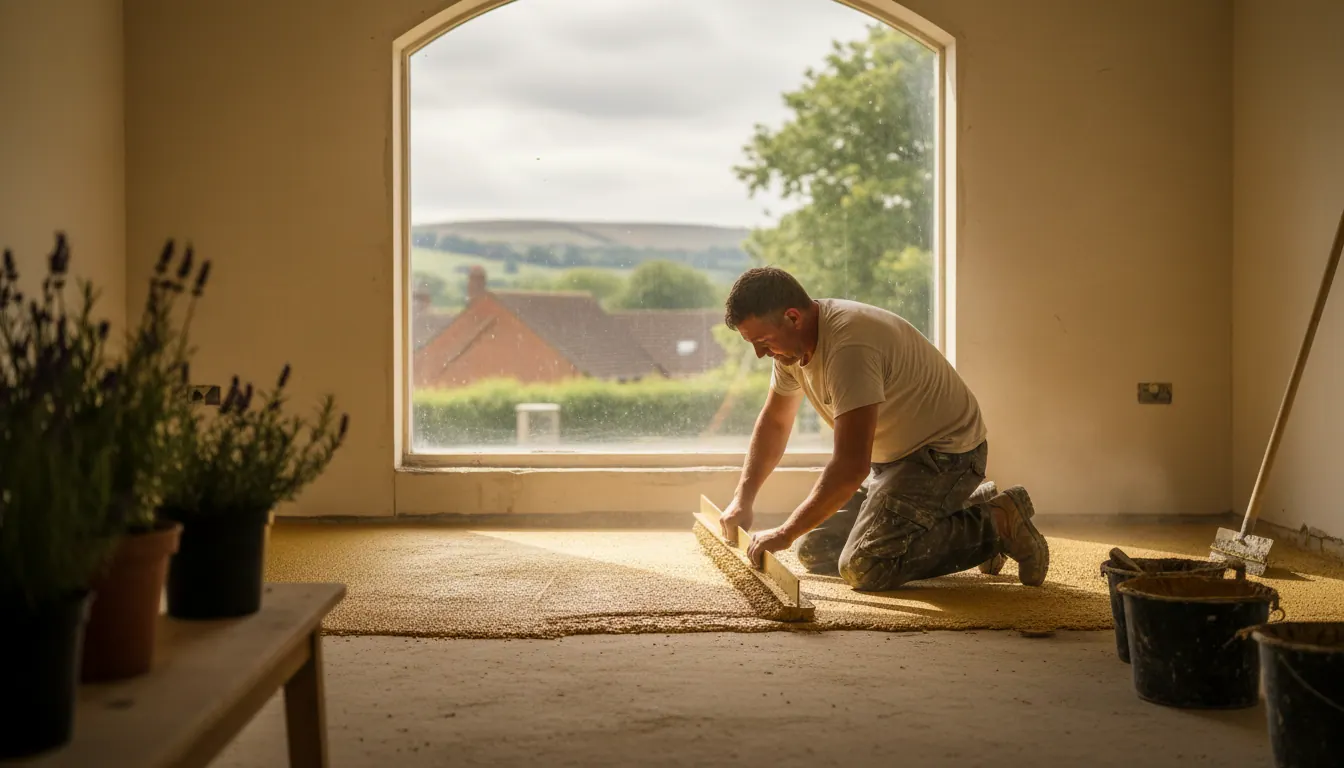
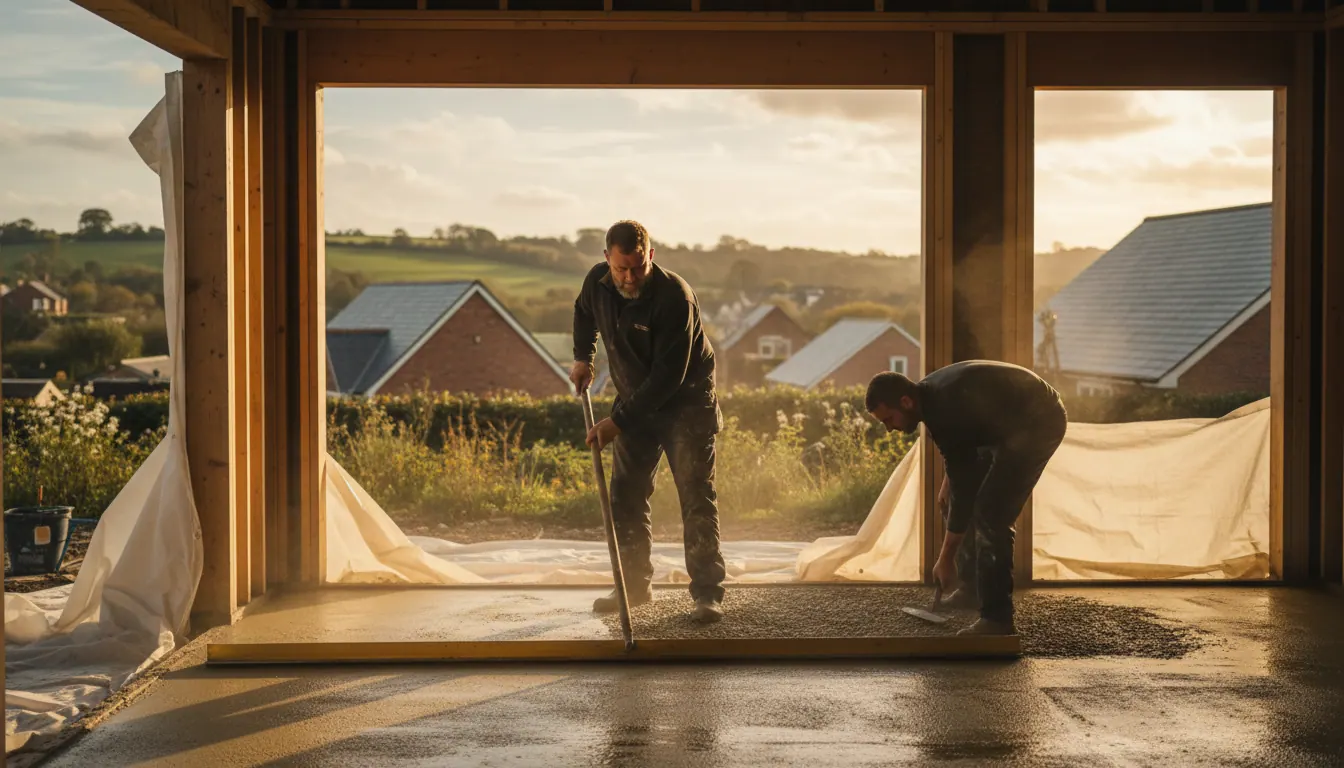
Liquid screed (sometimes called flowing screed or anhydrite screed) is a pumpable mixture that is pumped into the floor area and spread with a gauge bar or rake. Because it flows like a thick liquid, it finds its own level far more readily than traditional sand and cement screed, which is a drier, stiffer mix that has to be laid and tamped by hand.
That self-levelling behaviour is exactly what makes liquid screed well suited to floors that are not perfectly flat. A skilled operative can set datum points (reference markers fixed at the correct height), pump the screed in and let the material do much of the levelling work. The result is a smooth, consistent surface across the whole floor.
For a deeper look at how liquid screed compares to the traditional sand and cement approach, our article Liquid Screed vs Sand and Cement: Which Suits a Somerset Home? covers the differences in detail.
What happens before the pour: preparation matters
Getting a good result on an uneven floor starts before the screed lorry arrives. The preparation stage is where the real groundwork happens, and it directly affects the quality of the finished surface.
Here is what needs to be in place before we pour:
- Insulation boards laid flat and butted tightly together. Any gaps or humps in the insulation will telegraph through to the screed surface.
- A damp-proof membrane (a sheet of polythene or similar) to prevent moisture from the ground migrating up into the screed.
- Perimeter edge strip fixed around every wall, column and door reveal. This is a thin foam strip that separates the screed from the walls, allowing the slab to expand and contract without cracking.
- Underfloor heating pipes (if applicable) laid and pressure-tested by your heating installer before we arrive.
We can carry out the preparation work ourselves, including laying the insulation, membrane and edge strip, if that suits your build programme. Some builders and self-builders prefer to do this stage themselves; others find it easier to hand the whole floor over to us. Either way, the prep needs to be right.
If you want a full checklist, our Preparing Your Floor for Liquid Screed: A Somerset Checklist walks through every step.
How we handle a floor that is genuinely uneven
An uneven floor adds a layer of assessment to the job. Before quoting, we need to understand the degree of variation across the floor, because this affects how much screed is required and how the pour needs to be managed.
A few things we look at:
- The high and low points. A floor that dips in the middle by ten millimetres is a different job to one that slopes consistently from one end to the other, or one that has a raised section caused by an old hearth or a patched repair.
- Any high spots that cannot simply be covered. If there is a raised area, it may need to be ground down or cut back before the screed goes in. Adding screed on top of a high spot simply raises the whole floor height unnecessarily.
- The overall floor height. Every millimetre of screed you add raises the finished floor level. In a renovation, that matters: door thresholds, step heights and transitions to adjoining rooms all need to be thought through.
- The condition of the existing base. Loose, crumbling or contaminated substrates need to be addressed before the screed is poured. Liquid screed bonds to the base, and a weak base will cause problems.
This is why we ask for as much information as possible when you get in touch. Floor area, rough depth required, what is going on top and whether there is underfloor heating underneath: these details let us give you an accurate, useful quotation rather than a vague ballpark figure.
Is this a big job?
That depends on the floor. A single-room renovation pour is a relatively quick operation once the preparation is complete. A whole ground floor across a new build in Taunton or Yeovil, or a large commercial space in Weston-super-Mare, is a bigger undertaking but still typically completed in a single visit.
The drying time after the pour is where the programme planning matters most. Liquid screed needs time to cure before foot traffic, and longer before a floor finish can go down. Rushing this stage causes problems. Our article Is Screeding a Floor a Big Job? What Homeowners and Builders Need to Know goes into this in more detail, including what the process looks like from a builder's scheduling perspective.
What our customers say
We take care on every job, and that attention to detail matters on uneven floors more than anywhere, because the whole point is to end up with a surface that is genuinely flat.
Really happy with the work. The finish was spot on and you can tell a lot of care and attention went into getting everything right. Turned up when he said he would, worked hard and left everything tidy afterwards. Would definitely recommend to anyone looking for a reliable and professional screeding service.
Josh Phillips
A level, clean finish is the standard we aim for on every pour, whether that is a straightforward new build slab in Bridgwater or a tricky renovation floor with years of movement behind it.
Do I need a specialist, or can a plasterer or general builder do this?
This is a question we hear regularly. Plasterers work with similar materials in terms of consistency, and some general builders offer screeding as part of a broader service. But liquid screed is a specialist process. The pump equipment, the mix design, the setting of datums and the management of the pour all require experience to get right.
A floor that is not level, or that cracks because the mix was wrong or the preparation was inadequate, is expensive to put right. On an already uneven floor, where you are relying on the screed to do the levelling work, getting it right first time matters even more. We are liquid screed specialists, and this is what we do.
Frequently asked questions
Is screeding a floor a big job? It depends on the size of the floor and the amount of preparation needed. The pour itself is often completed in a single visit, even on large floors, because liquid screed is pumped in quickly and flows across the area. The preparation stage, and the drying period afterwards, are where most of the time is spent. For most domestic renovations in Somerset and Dorset, it is a manageable part of the build programme when planned in at the right stage.
Can I screed a floor myself? Technically, some people do attempt DIY screeding with bagged products, but liquid screed is not a DIY material. It requires specialist pump equipment, experience in setting accurate datums and knowledge of the mix. On an uneven floor especially, getting the levels right demands skill and the right tools. A poor pour is difficult and costly to fix, so for most homeowners the sensible answer is to use a specialist contractor.
Do plasterers do floor screeding? Some plasterers offer sand and cement screeding as an additional service, and the materials have surface similarities. But liquid screed is a separate specialism with different equipment, mix requirements and application techniques. If your floor is uneven and you need a reliably level result, a dedicated screeding contractor is the right choice.
What should I check before booking a screeding contractor in Somerset? Ask whether they supply and install the screed themselves or subcontract the pour. Confirm they can handle the preparation stage (insulation, membrane, edge strip) if you need that. Make sure they understand your floor finish, because depth requirements vary between tiles, wood and vinyl. And check they are familiar with screeding over underfloor heating if that applies to your project. We are happy to talk through all of this before you commit to anything.
Get in touch for a free quotation
If you have an uneven floor in Somerset or Dorset and want to know whether liquid screed is the right solution, get in touch with us. Tell us your floor area, roughly where you are (Bridgwater, Taunton, Yeovil, Weston-super-Mare or elsewhere in the area), and what the floor needs to do, and we will come back to you with a clear, free quotation. No obligation, no jargon.
Get in touch with us here and we will take it from there.